Leveraging Pell Grants Effectively: Maximizing Federal Aid for 2026-2027

Advertisements
Securing a Pell Grant is a vital step for millions of students heading into the 2026–2027 academic year.
As the cornerstone of federal aid, these funds do not require repayment, making them essential for reducing the financial burden of higher education.
This guide provides a streamlined look at the updated eligibility criteria and strategic application steps needed to navigate the evolving FAFSA landscape and ensure you receive the maximum funding possible for your studies.
Advertisements
Understanding Pell Grants for the 2026-2027 Academic Year
Pell Grants are a foundational element of federal student aid, designed to assist undergraduate students with exceptional financial need. These grants provide a direct contribution towards college costs, significantly reducing the burden of student loans.
For the 2026-2027 academic year, the maximum Pell Grant award and eligibility criteria will be determined by congressional appropriations and the student’s Expected Family Contribution (EFC) or Student Aid Index (SAI).
Advertisements
Understanding these fundamental aspects is the first step in effectively leveraging Pell Grants to finance your post-secondary education, ensuring you can focus on your studies without overwhelming financial stress.
What are Pell Grants and Who Qualifies?
Pell Grants are federal subsidies awarded to undergraduate students who demonstrate significant financial need and have not yet earned a bachelor’s or professional degree.
Eligibility is primarily determined by the information provided on the Free Application for Federal Student Aid (FAFSA).
Key factors include your family’s income and assets, family size, and the cost of attendance at your chosen institution.
The Department of Education uses a specific formula to calculate your Student Aid Index (SAI), which replaced the Expected Family Contribution (EFC) with the FAFSA Simplification Act, to determine your eligibility and award amount.
To qualify for Pell Grants, students must also meet general eligibility requirements, such as being a U.S. citizen or eligible non-citizen, having a valid Social Security number, and maintaining satisfactory academic progress.
These criteria are crucial for anyone considering Leveraging Pell Grants Effectively: Maximizing Federal Aid for Your 2026-2027 College Education.
- Pell Grants do not need to be repaid, unlike student loans.
- Eligibility is based on financial need, as determined by the FAFSA.
- Students must be pursuing their first undergraduate degree.
- Satisfactory academic progress is required to maintain eligibility.
Changes and Updates for 2026-2027
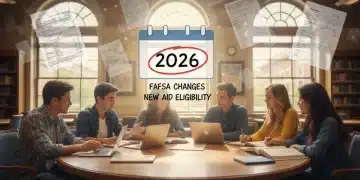
The FAFSA Simplification Act has brought significant changes to how federal student aid, including Pell Grants, is calculated and disbursed.
For the 2026-2027 academic year, these changes will be fully implemented, impacting the Student Aid Index (SAI) calculation.
The new FAFSA form itself has been streamlined, designed to be more user-friendly and accessible for students and families.
These updates aim to simplify the application process and expand eligibility for federal aid, potentially benefiting more students seeking to finance their education.
It is vital for applicants to familiarize themselves with these modifications to ensure a smooth application process and to accurately determine their potential Pell Grant award.
Staying current with these changes is a cornerstone of successfully Leveraging Pell Grants Effectively: Maximizing Federal Aid for Your 2026-2027 College Education.
Navigating the FAFSA: Your Gateway to Pell Grants
The Free Application for Federal Student Aid (FAFSA) is the single most important document for accessing Pell Grants and other federal financial aid. Completing this form accurately and on time is crucial for maximizing your aid opportunities.
The redesigned FAFSA for 2026-2027 promises a more intuitive experience, but attention to detail remains paramount. Errors or omissions can delay your application and potentially impact your eligibility for vital funding.
Understanding each section of the FAFSA and gathering all necessary documentation beforehand will streamline the process and increase your chances of securing the maximum possible Pell Grant award.
Key Dates and Deadlines for 2026-2027
While specific dates for the 2026-2027 FAFSA cycle are typically announced in the fall of 2025, it is generally expected that the application will open on October 1, 2025. This early opening allows students ample time to complete and submit their forms.
It is critical to note that federal, state, and institutional deadlines vary significantly. Many states and colleges have priority deadlines that, if missed, can reduce your chances of receiving all available aid, including Pell Grants.
Therefore, researching and marking all relevant deadlines on your calendar is a proactive step toward successfully Leveraging Pell Grants Effectively: Maximizing Federal Aid for Your 2026-2027 College Education.
Early submission is always recommended.
- Federal FAFSA submission deadline: Typically June 30 of the award year.
- State deadlines: Varies by state; often earlier than federal deadlines.
- College deadlines: Set by individual institutions; can be as early as January or February.
- Submitting early maximizes chances for limited aid funds.
Tips for Accurate and Timely FAFSA Submission
Accuracy is key when completing the FAFSA. Gather all required documents, including tax returns, W-2 forms, and records of untaxed income, before you begin the application.
Using the IRS Direct Data Exchange (DDX) can significantly reduce errors and simplify the process by directly importing tax information.
Pay close attention to questions regarding family size, household income, and assets, as these directly impact your Student Aid Index (SAI) and, consequently, your Pell Grant eligibility.
Double-checking all entries before submission can prevent common mistakes that lead to delays.
If you encounter difficulties, utilize the resources available, such as your high school guidance counselor, college financial aid offices, or the Federal Student Aid website.
These resources are designed to help you with Leveraging Pell Grants Effectively: Maximizing Federal Aid for Your 2026-2027 College Education.

Maximizing Your Pell Grant Award
While Pell Grants are needs-based, there are strategies students can employ to potentially maximize their award amount. Understanding how institutions calculate financial aid and how your personal circumstances play a role is vital.
Every dollar of grant money reduces the need for loans, making these strategies particularly valuable. Proactive steps can make a substantial difference in your overall financial aid package.
By carefully considering your academic choices and financial situation, you can position yourself to receive the most aid possible, which is central to Leveraging Pell Grants Effectively: Maximizing Federal Aid for Your 2026-2027 College Education.
Understanding the Student Aid Index (SAI)
The Student Aid Index (SAI) is a significant factor in determining your Pell Grant eligibility and award amount. It is a number calculated by the Department of Education using the financial information you provide on your FAFSA.
A lower SAI generally indicates a higher financial need, which can lead to a larger Pell Grant award. Factors like income, assets, family size, and the number of family members in college contribute to this calculation.
Understanding how your financial situation translates into your SAI can help you anticipate your Pell Grant eligibility and plan accordingly.
This knowledge is key for students focused on Leveraging Pell Grants Effectively: Maximizing Federal Aid for Your 2026-2027 College Education.
Choosing the Right College and Enrollment Status
The cost of attendance at your chosen institution directly influences the amount of financial aid you receive, even for Pell Grants. While the Pell Grant maximum is fixed, the gap it fills varies with tuition and fees.
Additionally, your enrollment status—full-time or part-time—affects your Pell Grant award. Generally, full-time students receive the full eligible amount, while part-time students receive a prorated portion.
Carefully considering these factors when making college decisions can significantly impact your overall financial aid package.
Strategic choices about where and how you enroll are crucial for Leveraging Pell Grants Effectively: Maximizing Federal Aid for Your 2026-2027 College Education.
- Enrollment in a full-time program typically yields the maximum Pell Grant.
- Part-time enrollment results in a reduced Pell Grant award.
- Choosing a college with a lower cost of attendance might reduce overall borrowing.
- Consider community colleges for initial years to minimize costs and maximize grant impact.
Maintaining Eligibility and Satisfactory Academic Progress
Receiving a Pell Grant is not a one-time event; students must maintain eligibility throughout their academic careers.
This includes adhering to specific academic and enrollment requirements set by both the federal government and their individual institutions.
Failing to meet these standards can result in the loss of your Pell Grant, creating unexpected financial challenges. Proactive monitoring of your academic standing and enrollment status is therefore essential.
Understanding and fulfilling these ongoing requirements ensures continued access to this vital federal aid.
Maintaining eligibility is as important as the initial application for Leveraging Pell Grants Effectively: Maximizing Federal Aid for Your 2026-2027 College Education.
Satisfactory Academic Progress (SAP) Requirements
Satisfactory Academic Progress (SAP) is a set of standards that students must meet to remain eligible for federal financial aid, including Pell Grants.
These standards typically include maintaining a minimum GPA, completing a certain percentage of attempted credits, and finishing your degree within a maximum timeframe.
Each college sets its own SAP policy, but all must meet federal guidelines. Students who fail to meet SAP requirements may lose their financial aid eligibility, though an appeal process is often available for extenuating circumstances.
Regularly checking your academic standing and understanding your institution’s SAP policy is crucial for uninterrupted financial support.
This diligence is a key component of Leveraging Pell Grants Effectively: Maximizing Federal Aid for Your 2026-2027 College Education.
Lifetime Eligibility Used (LEU)
There is a limit to the total amount of Pell Grant funding a student can receive over their lifetime, known as Lifetime Eligibility Used (LEU). This limit is currently the equivalent of 12 full-time semesters, or 600%.
Even if you do not receive the maximum Pell Grant each semester, any amount received contributes to your LEU. Exceeding this limit means you will no longer be eligible for Pell Grant funding, regardless of financial need.
Students should monitor their LEU, especially if they plan to change majors, transfer schools, or take longer to complete their degree.
Managing your LEU is a critical aspect of long-term financial planning and Leveraging Pell Grants Effectively: Maximizing Federal Aid for Your 2026-2027 College Education.
Beyond Pell Grants: Other Federal Aid Options
While Pell Grants are a cornerstone of federal financial aid, they are often just one piece of a larger financial aid puzzle. Many students will need to explore additional federal aid options to fully cover their college costs.
The FAFSA serves as the application for a wide range of federal programs, including other grants, work-study, and federal student loans. Understanding these options can provide a comprehensive financial aid strategy.
Combining various forms of aid can significantly reduce out-of-pocket expenses and minimize the need for private loans.
A holistic approach is essential when Leveraging Pell Grants Effectively: Maximizing Federal Aid for Your 2026-2027 College Education and other resources.
Federal Supplemental Educational Opportunity Grant (FSEOG)
The Federal Supplemental Educational Opportunity Grant (FSEOG) is another type of federal grant for undergraduate students with exceptional financial need.
Unlike Pell Grants, FSEOG funds are limited and allocated directly to colleges, which then distribute them to eligible students.
Because funds are limited, FSEOGs are typically awarded to students with the lowest Student Aid Index (SAI) who also receive Pell Grants.
Early FAFSA submission is highly recommended to be considered for FSEOG, as funds are often awarded on a first-come, first-served basis.
This grant provides an additional layer of support for the most financially vulnerable students. Securing an FSEOG alongside your Pell Grant significantly enhances your overall federal aid package.
Federal Work-Study Program
The Federal Work-Study Program provides part-time jobs for undergraduate and graduate students with financial need, allowing them to earn money to help pay for educational expenses.
These jobs are often related to the student’s field of study or community service.
Work-study earnings do not count against your financial aid eligibility in subsequent FAFSA applications, making it a particularly attractive option. It offers valuable work experience while providing financial support.
Participating in the Federal Work-Study Program can reduce your reliance on loans and provide practical skills. It’s an excellent complement to Leveraging Pell Grants Effectively: Maximizing Federal Aid for Your 2026-2027 College Education.
Federal Student Loans
For many students, Pell Grants and other grants may not cover the entirety of their college expenses, necessitating federal student loans.
These loans, offered by the U.S. Department of Education, typically have lower interest rates and more flexible repayment terms than private loans.
Federal student loans come in different forms, including Direct Subsidized Loans (for undergraduate students with financial need, interest paid by the government during certain periods) and Direct Unsubsidized Loans (available to all undergraduate and graduate students, regardless of financial need).
Understanding the differences between loan types and borrowing only what is necessary is crucial for managing future debt.
Federal loans can fill the remaining financial gap after Leveraging Pell Grants Effectively: Maximizing Federal Aid for Your 2026-2027 College Education and other grant opportunities.
Resources and Support for Pell Grant Applicants
Navigating the financial aid process can feel overwhelming, but numerous resources are available to assist students and families. These support systems are designed to provide guidance, answer questions, and help ensure a successful application.
From federal websites to college financial aid offices, knowing where to turn for help can make a significant difference. Utilizing these resources can simplify complex procedures and clarify eligibility requirements.
Accessing expert advice and reliable information is a smart move for anyone committed to Leveraging Pell Grants Effectively: Maximizing Federal Aid for Your 2026-2027 College Education.

Federal Student Aid Website and Help Center
The official Federal Student Aid (FSA) website, StudentAid.gov, is the primary resource for all federal financial aid information. It offers detailed guides, FAQs, and tools to help students complete the FAFSA and understand their aid options.
The website also hosts the FAFSA form itself and provides access to your personal financial aid history, including your Lifetime Eligibility Used (LEU).
The FSA Help Center provides direct contact information for assistance with specific questions or technical issues.
This comprehensive online platform is an indispensable tool for students and families. Regularly consulting StudentAid.gov is a best practice for Leveraging Pell Grants Effectively: Maximizing Federal Aid for Your 2026-2027 College Education.
College Financial Aid Offices
Every accredited college and university has a financial aid office staffed with professionals dedicated to assisting students.
These offices can provide personalized guidance on completing the FAFSA, understanding your aid offer, and exploring institutional scholarships.
They can also help you navigate specific college deadlines, appeal financial aid decisions, and understand Satisfactory Academic Progress (SAP) requirements.
Financial aid officers are experts in their field and can offer tailored advice based on your unique situation.
Establishing a relationship with your college’s financial aid office is highly beneficial throughout your academic journey.
Their expertise is invaluable for fully Leveraging Pell Grants Effectively: Maximizing Federal Aid for Your 2026-2027 College Education.
High School Counselors and Community Organizations
High school guidance counselors often have extensive experience with the FAFSA and the college application process. They can provide initial guidance, help organize necessary documents, and connect students with additional resources.
Many community organizations also offer free financial aid workshops and one-on-one assistance to students and families. These services can be particularly helpful for first-generation college students or those from underserved communities.
Leveraging these local resources can provide crucial support and ensure that no student misses out on potential aid due to lack of information or assistance.
These networks are vital for successfully Leveraging Pell Grants Effectively: Maximizing Federal Aid for Your 2026-2027 College Education.
Strategic Planning for Long-Term College Funding
While securing Pell Grants for the 2026-2027 academic year is a significant achievement, a broader, long-term financial strategy is essential for sustained college funding.
This involves looking beyond immediate grants to consider future aid, potential scholarships, and wise borrowing.
Planning proactively for each academic year can prevent unexpected financial shortfalls and reduce overall student debt. A comprehensive approach ensures a more stable and less stressful educational journey.
Developing a robust financial plan is crucial for not only Leveraging Pell Grants Effectively: Maximizing Federal Aid for Your 2026-2027 College Education but also for covering all subsequent years of study.
Reapplying for FAFSA Annually
It is imperative to remember that you must reapply for the FAFSA every single year you wish to receive federal financial aid. Your financial situation can change from year to year, which may affect your eligibility for Pell Grants and other aid.
Submitting the FAFSA annually ensures that your financial need is reassessed and that you are considered for all available federal, state, and institutional aid. Missing a year means missing out on potential funding.
Make FAFSA submission an annual priority to ensure continuous financial support. Consistent annual applications are key to Leveraging Pell Grants Effectively: Maximizing Federal Aid for Your 2026-2027 College Education throughout your degree.
Exploring Scholarship Opportunities
Beyond federal aid, scholarships offer another excellent source of free money for college.
These funds do not need to be repaid and are awarded based on a wide range of criteria, including academic merit, athletic talent, specific majors, community service, or even unique hobbies.
Many colleges offer institutional scholarships, and countless private organizations, foundations, and businesses provide scholarships. Dedicate time to searching for and applying to as many relevant scholarships as possible.
Combining Pell Grants with scholarships can significantly reduce your overall college costs and minimize the need for student loans. This multi-faceted approach is integral to a strong financial aid strategy.
Budgeting and Financial Literacy
Effective budgeting and strong financial literacy are critical skills for all college students.
Understanding how to manage your Pell Grant funds, other financial aid, and personal finances can prevent financial stress and ensure you make the most of your resources.
Create a realistic budget that accounts for tuition, fees, housing, books, and personal expenses. Track your spending, look for ways to save money, and avoid unnecessary debt.
Developing good financial habits now will serve you well throughout college and beyond. Smart financial management complements Leveraging Pell Grants Effectively: Maximizing Federal Aid for Your 2026-2027 College Education.
| Key Point | Brief Description |
|---|---|
| FAFSA 2026-2027 | Streamlined application essential for all federal aid, including Pell Grants. |
| Student Aid Index (SAI) | Replaced EFC; determines grant eligibility and award amount based on financial need. |
| Eligibility Maintenance | Requires satisfactory academic progress (SAP) and monitoring Lifetime Eligibility Used (LEU). |
| Maximizing Aid | Combine Pell Grants with other federal aid, scholarships, and wise budgeting. |
Frequently Asked Questions About Pell Grants
The maximum Pell Grant award for 2026-2027 is subject to congressional appropriation. While the exact figure is not yet finalized, it is typically announced closer to the FAFSA opening date, usually in late 2025. Students should monitor official Federal Student Aid updates for the most current information.
The Student Aid Index (SAI) is a number calculated from your FAFSA data that determines your financial need. A lower SAI indicates a higher financial need, which generally results in a larger Pell Grant award, up to the maximum. The SAI replaces the previous Expected Family Contribution (EFC).
No, Pell Grants are exclusively for undergraduate students pursuing their first bachelor’s degree or a post-baccalaureate teacher certification program. Graduate students are not eligible for Pell Grants but may qualify for other forms of federal financial aid, such as federal student loans or graduate-specific grants.
If you fail to meet your college’s Satisfactory Academic Progress (SAP) requirements, you risk losing your eligibility for federal financial aid, including Pell Grants. Most institutions offer an appeal process for students with extenuating circumstances. It is crucial to understand and adhere to your school’s specific SAP policy.
Yes, you must complete and submit the Free Application for Federal Student Aid (FAFSA) every year you wish to receive federal financial aid, including Pell Grants. Your financial circumstances can change annually, and reapplication ensures your eligibility and award amount are accurately reassessed.
Looking Ahead: Sustaining Your College Funding Journey
Effectively leveraging Pell Grants is more than just a one-time application; it’s an ongoing commitment to understanding and navigating the financial aid landscape for the 2026–2027 academic year.
With the maximum award set at $7,395, students must remain vigilant about new regulations, such as the inclusion of foreign income in eligibility calculations and the “150% year-round Pell” rule that can help fund summer terms.
The proactive engagement with financial aid offices, coupled with a strategic approach to scholarships and responsible borrowing, will empower students to achieve their educational aspirations with minimized financial stress.
This journey underscores the importance of continuous learning—not just in academics, but in financial literacy.
For a deeper understanding of why these grants remain a cornerstone of equity, explore Pell Grants: A Key Tool for Expanding College Access and Economic Opportunity.