Bridging the Gap: 6 In-Demand Education Pathways for US Job Seekers 2026
Advertisements
The US job market in 2026 is facing a profound, structural skills gap driven by rapid technological and economic shifts.
This report delivers a direct, objective analysis of the six most in-demand educational pathways, offering job seekers a practical roadmap to acquire specialized, high-impact competencies and build long-term career resilience.
Navigating the Digital Frontier: Cybersecurity and Data Science
The digital transformation sweeping across all sectors has made cybersecurity and data science indispensable fields.
Advertisements
As companies increasingly rely on digital infrastructure and data-driven decision-making, the demand for skilled professionals in these areas continues to outpace supply.
This creates significant opportunities for those who pursue specialized training.
Cybersecurity professionals are tasked with protecting sensitive information and critical systems from ever-evolving threats.
Advertisements
Data scientists, on the other hand, extract valuable insights from vast datasets, guiding business strategies and fostering innovation. Both roles are foundational to modern economic operations and require continuous learning.
The urgency to fill these roles is evident in the high salaries and abundant job openings observed across the nation.
Educational institutions are responding by developing robust programs, but the pace of technological change means that formal education must be complemented by continuous professional development to remain competitive in the US Skills Gap 2026.
Cybersecurity Specialists: Protecting Digital Assets
Cybersecurity threats are growing in sophistication and frequency, making robust defenses a top priority for businesses and governments.
This field requires individuals with strong analytical skills, a deep understanding of network architectures, and proficiency in various security protocols and tools.
Certifications from organizations like CompTIA, (ISC)², and GIAC are highly valued, alongside degrees in computer science or information technology.
The demand spans various specializations, including ethical hacking, incident response, security architecture, and compliance.
These roles are not confined to tech companies but are crucial for finance, healthcare, manufacturing, and retail.
Continuous education is vital as new vulnerabilities and protective measures emerge regularly, making it a key component of addressing the US Skills Gap 2026.
- Certified Information Systems Security Professional (CISSP).
- CompTIA Security+ and CySA+.
- Certified Ethical Hacker (CEH) credentials.
Data Scientists and Analysts: Unlocking Insights from Information
Data is often called the new oil, and data scientists are the engineers who refine it into actionable intelligence.
With the explosion of big data, organizations need experts who can collect, process, analyze, and interpret complex datasets to inform strategic decisions.
This field requires a blend of statistical knowledge, programming skills (Python, R), and domain expertise.
Roles range from data analysts who interpret existing data to machine learning engineers who develop predictive models.
Educational pathways include master’s degrees in data science, statistics, or computer science, as well as specialized bootcamps and certifications.
The ability to communicate complex findings clearly is also a crucial skill for these professionals, contributing directly to bridging the US Skills Gap 2026.
- Master’s degrees in Data Science or Analytics.
- Certifications in Python, R, and SQL.
- Expertise in machine learning frameworks.
Healthcare Innovation: Telemedicine and Health Informatics
The healthcare sector is undergoing a massive transformation, driven by technological advancements and changing patient needs.
Telemedicine and health informatics are at the forefront of this evolution, creating a significant demand for specialized professionals.
These fields are not just about medical care but also about how technology can enhance and streamline healthcare delivery.
Telemedicine, accelerated by recent global events, connects patients with providers remotely, expanding access to care and improving efficiency.
Health informatics, meanwhile, focuses on managing and analyzing healthcare data to improve patient outcomes, reduce costs, and support clinical research.
Both areas require a unique blend of technical and medical knowledge to effectively address the US Skills Gap 2026.
The integration of technology into healthcare is irreversible, meaning that professionals with skills in these domains will be highly sought after.
Educational programs are adapting to provide the interdisciplinary training necessary for these roles, making them attractive pathways for career growth.
The emphasis is on practical applications and understanding the regulatory landscape of healthcare.
Telemedicine Specialists: Expanding Access to Care
Telemedicine encompasses a wide range of services, from virtual consultations to remote monitoring of chronic conditions.
Professionals in this area need to understand both medical practices and the technological platforms that enable remote care.
This includes knowledge of secure communication systems, digital diagnostic tools, and patient data privacy regulations.
Roles can include telemedicine coordinators, technical support specialists for virtual platforms, and healthcare providers trained in virtual care delivery.
Training often involves certifications in health IT, digital health, or specialized modules within existing medical and nursing programs.
The expansion of telemedicine is a critical component in ensuring equitable healthcare access and is a burgeoning area for addressing the US Skills Gap 2026.
- Certifications in Telehealth Technology.
- Training in secure patient data management.
- Understanding of HIPAA compliance in virtual settings.
Health Informatics Professionals: Optimizing Healthcare Data
Health informatics is the bridge between healthcare and information technology.
These professionals manage health information systems, analyze patient data to identify trends, and develop strategies to improve healthcare delivery and policy.
Their work is crucial for everything from electronic health record (EHR) implementation to public health surveillance.
Degrees in health informatics, health information management, or related fields are highly beneficial.
Expertise in data analytics, database management, and understanding medical terminology are essential.
The goal is to leverage data to enhance efficiency, quality, and safety in healthcare, making this a vital pathway for those looking to contribute significantly to the healthcare ecosystem and fill the US Skills Gap 2026.
- Master’s in Health Informatics.
- Proficiency in EHR systems and medical coding.
- Data analysis skills for healthcare outcomes.
Green Economy: Renewable Energy and Sustainability
The global shift towards a sustainable future is creating a new wave of job opportunities within the green economy.
Renewable energy and sustainability sectors are experiencing rapid growth, driven by environmental concerns, policy initiatives, and technological advancements.
This expansion translates into a significant demand for a skilled workforce capable of designing, implementing, and maintaining green solutions.
From solar panel installation to developing sustainable urban planning strategies, the range of roles is diverse and constantly evolving.
These fields require both technical expertise and a deep understanding of environmental principles.
Investing in education within the green economy not only provides promising career prospects but also contributes to global efforts to combat climate change and resource depletion.
Government incentives and increasing corporate commitments to sustainability are further fueling this demand.
Job seekers who acquire skills in these areas will find themselves at the forefront of a transformative industry, playing a crucial role in shaping a more environmentally responsible future and directly addressing the US Skills Gap 2026.
Renewable Energy Technicians: Powering the Future
The transition from fossil fuels to renewable energy sources like solar, wind, and geothermal power requires a specialized workforce.
Renewable energy technicians are responsible for the installation, maintenance, and repair of these complex systems. This includes solar photovoltaic installers, wind turbine technicians, and biofuel production operators.
Vocational training programs, associate degrees, and certifications are common pathways into these roles. Practical skills in electrical systems, mechanical repair, and safety protocols are essential.
As renewable energy infrastructure expands, the demand for these hands-on technical roles will only continue to grow, forming a significant part of the US Skills Gap 2026 that needs to be filled.
- Solar Photovoltaic (PV) installation certification.
- Wind turbine technician training.
- Electrical and mechanical system proficiency.
Advanced Manufacturing and Robotics: Reshaping Production
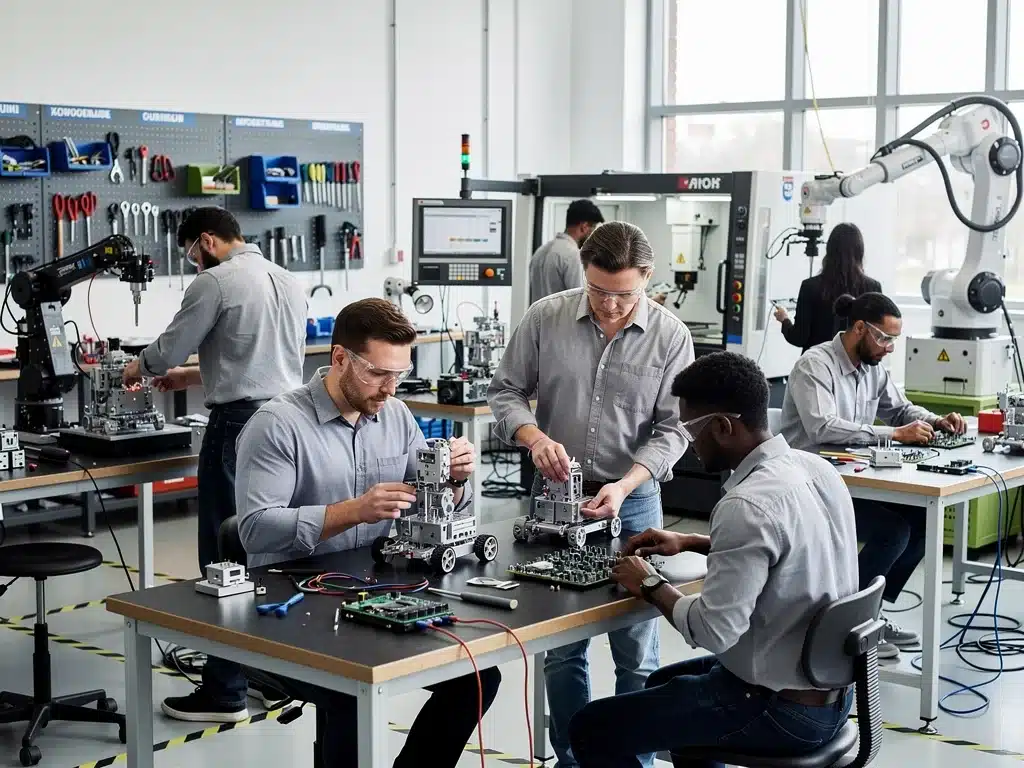
Advanced manufacturing is revolutionizing how goods are produced, integrating cutting-edge technologies like automation, robotics, and artificial intelligence into production processes.
This paradigm shift requires a highly skilled workforce capable of operating, programming, and maintaining sophisticated machinery.
The resurgence of manufacturing in the US, coupled with technological innovation, is creating a strong demand for these specialized skills.
Robotics, in particular, is transforming assembly lines, logistics, and quality control, leading to increased efficiency and precision.
However, this advancement necessitates human operators and engineers who can manage these complex systems. The blend of mechanical, electrical, and computer science knowledge is crucial for success in this evolving sector.
Educational pathways in advanced manufacturing and robotics prepare individuals for roles that are critical to maintaining the nation’s competitive edge in global production.
These fields offer stable and well-paying jobs for those who embrace continuous learning and adaptation to new technologies, directly addressing the US Skills Gap 2026 in industrial capabilities.
Robotics Engineers and Technicians: Automation Experts
Robotics engineers design, build, test, and maintain robots and robotic systems. Robotics technicians install, troubleshoot, and repair these systems in manufacturing plants, laboratories, and other industrial settings.
These roles require a strong foundation in engineering principles, including mechanical, electrical, and software engineering.
Degrees in robotics, mechatronics, or electrical engineering are highly sought after. Vocational training and certifications in industrial automation and programmable logic controllers (PLCs) are also valuable.
The ability to program robots and integrate them into existing production lines is a key skill. This specialization is fundamental for the future of US industry and a core area for the US Skills Gap 2026.
- Degrees in Robotics or Mechatronics Engineering.
- Certifications in industrial automation and PLCs.
- Programming skills for robotic systems.
Additive Manufacturing Specialists: 3D Printing Pioneers
Additive manufacturing, commonly known as 3D printing, is transforming product development and production across industries, from aerospace to healthcare.
Specialists in this field design, operate, and maintain 3D printers, working with various materials to create prototypes and functional parts.
This technology enables rapid iteration and customization, offering significant advantages over traditional manufacturing methods.
Educational pathways include engineering degrees with a focus on materials science or manufacturing, as well as specialized certifications in additive manufacturing processes and software.
Expertise in CAD/CAM software and understanding different printing technologies (e.g., FDM, SLA, SLS) are crucial. This innovative field is rapidly growing, contributing significantly to the demand side of the US Skills Gap 2026.
- Specialized certifications in Additive Manufacturing.
- Proficiency in CAD/CAM software.
- Knowledge of various 3D printing technologies.
Cloud Computing and AI Development: The Infrastructure of Tomorrow
Cloud computing and artificial intelligence (AI) development form the backbone of modern technological infrastructure.
Almost every industry now leverages cloud services for scalability, efficiency, and data storage, while AI is becoming integral to automation, decision-making, and personalized experiences.
The rapid evolution of these technologies creates a persistent and growing demand for skilled professionals.
Cloud architects, engineers, and AI developers are critical for designing, implementing, and managing these complex systems.
Their expertise ensures that businesses can harness the full potential of these innovative platforms. This sector is characterized by continuous innovation, requiring professionals to stay updated with the latest tools and methodologies.
Educational programs focusing on these areas are essential for preparing the workforce for future challenges.
The demand for these skills is not limited to tech companies; organizations across all sectors are seeking talent to integrate cloud and AI solutions into their operations, thereby contributing to closing the US Skills Gap 2026.
Cloud Architects and Engineers: Building Digital Foundations
Cloud architects design and implement cloud infrastructure, ensuring scalability, security, and cost-effectiveness.
Cloud engineers are responsible for the deployment, management, and operation of cloud environments on platforms like AWS, Azure, and Google Cloud. These roles are fundamental to any organization’s digital strategy.
Certifications from major cloud providers (e.g., AWS Certified Solutions Architect, Microsoft Certified: Azure Administrator Associate) are highly valued, often alongside degrees in computer science or related engineering fields.
Strong networking, operating system, and automation skills are also crucial. The continuous evolution of cloud services means ongoing learning is a necessity for these professionals, directly impacting the US Skills Gap 2026.
- AWS, Azure, or Google Cloud certifications.
- Proficiency in infrastructure as code (IaC) tools.
- Strong understanding of network and system architecture.
AI Developers and Machine Learning Engineers: Creating Intelligent Systems
AI developers and machine learning engineers are at the forefront of creating intelligent systems that can learn from data, make predictions, and automate complex tasks.
They design and implement algorithms, build AI models, and integrate them into various applications, from chatbots to autonomous vehicles.
Advanced degrees in computer science, artificial intelligence, or data science are common, complemented by strong programming skills (Python, Java) and expertise in machine learning frameworks (TensorFlow, PyTorch).
Understanding statistical modeling and neural networks is also essential. This field is rapidly expanding, offering immense opportunities for innovation and addressing a critical segment of the US Skills Gap 2026.
- Master’s or Ph.D. in AI or Machine Learning.
- Expertise in Python, TensorFlow, and PyTorch.
- Strong mathematical and statistical foundations.
Digital Marketing and E-commerce Management: Connecting with Consumers
In an increasingly digital world, effective communication and commerce rely heavily on digital marketing and e-commerce strategies.
Businesses of all sizes need skilled professionals who can navigate the complexities of online platforms, attract customers, and drive sales.
This sector is dynamic and requires a blend of creativity, analytical thinking, and technical proficiency.
Digital marketers craft compelling campaigns, manage social media presence, and optimize search engine visibility.
E-commerce managers oversee online stores, ensuring seamless customer experiences and efficient operations. Both roles are vital for brand visibility and revenue generation in today’s competitive landscape.
The continuous evolution of digital tools and consumer behavior means that professionals in these fields must constantly update their skills.
Educational pathways range from specialized certifications to bachelor’s and master’s degrees, all aimed at preparing individuals for the demands of the modern marketplace and helping to address the US Skills Gap 2026 in consumer engagement.
Digital Marketing Strategists: Driving Online Engagement
Digital marketing strategists develop and execute comprehensive online marketing campaigns.
This includes search engine optimization (SEO), search engine marketing (SEM), social media marketing, content creation, email marketing, and analytics.
Their goal is to increase brand awareness, generate leads, and convert customers through digital channels.
Certifications from Google (e.g., Google Ads, Google Analytics), HubSpot, and other industry leaders are highly beneficial.
Degrees in marketing, communications, or business with a digital focus are also valuable. A strong understanding of consumer psychology and the ability to analyze campaign performance are crucial.
This role is essential for businesses to thrive online and contributes to closing the US Skills Gap 2026.
- Google Ads and Analytics certifications.
- Proficiency in social media marketing platforms.
- Content marketing and SEO expertise.
E-commerce Managers: Optimizing Online Sales
E-commerce managers are responsible for the overall success of an online store. This includes managing product listings, optimizing website performance, overseeing logistics, handling customer service, and analyzing sales data.
They work to ensure a smooth and profitable online shopping experience for customers.
Experience with e-commerce platforms (e.g., Shopify, Magento, WooCommerce) and knowledge of web analytics are essential. Business degrees with a specialization in e-commerce or digital business are highly relevant.
Strong organizational skills, attention to detail, and a customer-centric approach are key to success in this role, which is vital for the modern retail landscape and the US Skills Gap 2026.
- Experience with major e-commerce platforms.
- Web analytics and conversion rate optimization.
- Supply chain and logistics understanding.
| Key Pathway | Brief Description |
|---|---|
| Cybersecurity | Protecting digital assets from threats; high demand in all sectors. |
| Data Science | Extracting insights from data for strategic decision-making. |
| Healthcare Informatics | Managing healthcare data to improve patient outcomes and efficiency. |
| Renewable Energy | Installation and maintenance of sustainable energy systems. |
Frequently Asked Questions About US Skills Gap 2026
The primary cause stems from rapid technological advancements and evolving industry demands outpacing the traditional education system’s ability to adapt. Automation, AI, and digital transformation necessitate new competencies that a significant portion of the workforce currently lacks, creating a persistent mismatch between available talent and job requirements.
Job seekers should focus on continuous learning and upskilling in high-demand areas like cybersecurity, data science, and green technologies. Pursuing specialized certifications, vocational training, or advanced degrees aligned with these critical pathways will significantly enhance employability and career longevity in the evolving market.
While traditional degrees provide a strong foundational knowledge, they often need to be supplemented with specialized certifications or practical training to meet specific industry needs. The emphasis is increasingly on applied skills and continuous professional development, making a blend of formal education and targeted training highly effective for the US Skills Gap 2026.
Employers play a crucial role by investing in employee training and reskilling programs. Collaborating with educational institutions to design relevant curricula and offering apprenticeships can also help cultivate the necessary talent. Proactive engagement from businesses is essential to developing a workforce that meets future demands effectively.
Sectors most affected include technology (cybersecurity, AI, cloud computing), healthcare (telemedicine, health informatics), and advanced manufacturing. The green economy and digital marketing also show significant gaps. These industries are undergoing rapid transformation, necessitating specialized skills that are currently in short supply.
Looking Ahead
The ongoing challenge of the US Skills Gap 2026 underscores a critical need for adaptive strategies across education and industry.
The pathways identified—cybersecurity, data science, healthcare innovation, green economy, advanced manufacturing, and digital marketing—are not merely trends but foundational shifts in the economic landscape.
Proactive engagement from job seekers, educational institutions, and employers will determine the nation’s capacity to meet future demands.
This alignment relies on actively connecting academic research with practical policy decisions and industry requirements. Fostering this synergy helps translate classroom training into direct, real-world impact.
To learn more about how organizations are fostering these essential connections between academic scholarship and practical policy-making, you can visit the Bridging the Gap Project.
Monitoring shifts in technology and policy will be crucial to staying ahead in this dynamic environment, ensuring a resilient and competitive workforce for the United States.