Dual Enrollment vs. Advanced Placement: How Earning 15 College Credits in High School Accelerates Degree Completion

Advertisements
Earning university credits while still in high school is one of the smartest ways to slash future tuition costs and graduate early. Choosing a Dual Enrollment program allows students to take actual college courses, guaranteeing transferable credit upon passing the class.
In contrast, Advanced Placement classes rely on a single high-stakes standardized exam at the end of the year to qualify for college credit. Concurrent enrollment programs provide a transcript grade through local community colleges, bypassing single-test pressure entirely.
Evaluating course transferability, workload, and long-term academic goals helps high schoolers select the fastest path toward a degree. Here is a clear comparison of both accelerated pathways to help you make the right choice.
Advertisements
Understanding Dual Enrollment: Direct College Credit
Dual Enrollment programs allow high school students to take college-level courses, typically at a local college or university, and earn both high school and college credit simultaneously. These courses are often taught by college professors, providing a true university experience from an earlier stage.
This direct exposure to college academics can be invaluable for students, helping them adapt to the rigor and expectations of higher education before they officially enroll.
Advertisements
The credits earned are generally transferable, though students should always verify with their prospective four-year institutions.
Many states and school districts are expanding Dual Enrollment opportunities, recognizing their potential to boost college readiness and reduce the overall cost of a bachelor’s degree. It represents a tangible step towards accelerating degree completion.
Program Structure and Course Delivery
Dual Enrollment courses can be offered in various formats: on a college campus, at the high school with an approved college instructor, or online. The flexibility in delivery makes it accessible to a broader range of students.
Students typically register directly with the college offering the courses, adhering to college-level academic calendars and deadlines. This experience helps students develop time management and organizational skills essential for university success.
Course selection usually mirrors freshman-level college curricula, covering subjects like English composition, mathematics, history, and science. This allows students to fulfill general education requirements before even graduating high school, directly contributing to accelerating degree completion.
- Direct college credit earned upon successful completion.
- Exposure to college environment and academic rigor.
- Potential for significant cost savings on college tuition.
Benefits of Dual Enrollment
One of the primary advantages of Dual Enrollment is the immediate college credit received, which can directly reduce the number of courses a student needs to take in college. This translates to potential savings on tuition, fees, and living expenses.
Students gain a clearer understanding of college expectations and develop stronger study habits, easing their transition into higher education. This early exposure often leads to higher retention rates and improved academic performance in college.
For those aiming for specific career paths, Dual Enrollment can provide an early start on specialized coursework, further accelerating degree completion. It offers a practical and tangible head start on their academic journey.
Exploring Advanced Placement: Standardized College Credit
Advanced Placement (AP) programs, administered by the College Board, offer high school students the opportunity to take rigorous, college-level courses within their high school environment.
Unlike Dual Enrollment, college credit for AP is typically earned by achieving a qualifying score on a standardized AP exam at the end of the course.
AP courses are widely recognized by colleges and universities across the United States and internationally, making them a popular choice for academically motivated students. The curriculum is standardized, ensuring a consistent level of challenge and content.
Students often take multiple AP courses throughout their high school career, aiming to accumulate a significant number of college credits. This approach is another viable path to accelerating degree completion and demonstrating academic prowess to college admissions committees.
Course Structure and Exam Requirements
AP courses are taught by high school teachers who have received specialized training and adhere to College Board curriculum guidelines. The courses are designed to be equivalent to introductory college courses.
At the end of the academic year, students take a comprehensive AP exam, typically scored on a scale of 1 to 5. A score of 3, 4, or 5 is generally considered a qualifying score for college credit, though policies vary by institution.
The emphasis on a single, high-stakes exam can be a point of difference compared to Dual Enrollment, where credit is awarded based on semester-long performance. This structure tests not only knowledge but also exam-taking strategies.
- Direct college credit earned upon successful completion.
- Exposure to college environment and academic rigor.
- Potential for significant cost savings on college tuition.
Benefits of Advanced Placement
AP courses provide a challenging academic experience that can strengthen a student’s college application, showcasing their ability to handle rigorous coursework. Success in AP courses and exams can lead to college credit, reducing the number of courses needed in college.
Beyond credit, AP programs foster critical thinking, analytical skills, and strong study habits, preparing students for the intellectual demands of university life. Many colleges view AP participation favorably during the admissions process.
The flexibility of taking AP courses within the high school setting can also be a benefit, allowing students to remain engaged in extracurricular activities and school life while pursuing advanced academics. This can be a key factor in accelerating degree completion.
Key Differences: Dual Enrollment vs. Advanced Placement
The fundamental distinction between Dual Enrollment and Advanced Placement lies in how college credit is awarded and the learning environment. Dual Enrollment provides direct college credit upon successful completion of a college course, often taught by college faculty.
Advanced Placement, conversely, requires a qualifying score on a standardized exam to earn college credit, with courses typically taught by high school teachers. This difference impacts the immediate certainty of credit transfer.
Another significant difference is the academic setting. Dual Enrollment often exposes students to a college campus or online college platforms, while AP courses are integrated into the high school curriculum. Both offer unique preparatory experiences.
Credit Transferability and Acceptance
For Dual Enrollment, credits are generally considered college credits from the outset, making them more straightforward to transfer. However, students must still verify with their intended four-year institution regarding specific course equivalencies and transfer policies.
AP credit acceptance varies more widely among universities. While many institutions accept AP scores for credit, some may only grant elective credit, require higher scores for specific courses, or limit the total number of AP credits applied towards a degree.
This makes understanding each university’s policy crucial.
Researching individual college policies on Dual Enrollment vs. Advanced Placement credit is a vital step for students planning to accelerate their degree completion. This proactive approach ensures that the efforts made in high school truly count towards their college degree.
Financial Implications: Cost Savings and ROI
Both Dual Enrollment and Advanced Placement offer significant financial advantages by potentially reducing the overall cost of a college degree. Earning 15 college credits in high school can translate into saving an entire semester or even a year of tuition and fees.
Dual Enrollment tuition costs can vary; some programs are free for students through state funding or district partnerships, while others require a reduced tuition rate. These savings can be substantial compared to standard college tuition rates.
AP courses involve a fee for each exam, which is considerably less than the cost of a college course.
However, the credit is contingent on the exam score, meaning the investment in the exam fee might not always yield college credit. Evaluating the Dual Enrollment vs. Advanced Placement costs is essential.
Long-Term Financial Benefits
Accelerating degree completion through either program can lead to entering the workforce sooner, thereby starting to earn an income earlier. This represents a significant return on investment for the time and effort spent in high school.
Reducing the number of semesters needed for a degree also lessens expenses like housing, meal plans, and transportation, which can accumulate rapidly over a four-year period. These ancillary costs are often overlooked but contribute substantially to the total cost of college.
For families concerned about student loan debt, both Dual Enrollment and Advanced Placement provide pathways to mitigate this burden.
The financial foresight demonstrated by engaging in these programs can have lasting positive impacts on a student’s financial future. The discussion around Dual Enrollment vs. Advanced Placement frequently highlights these fiscal advantages.
Academic Preparedness and College Transition
Beyond credits and cost savings, both Dual Enrollment and Advanced Placement play a crucial role in preparing students for the academic rigors of college. They introduce students to higher-level thinking, research skills, and independent learning.
Dual Enrollment, by immersing students in a college environment, offers a realistic preview of university life. Students learn to navigate college systems, interact with professors, and manage their schedules, fostering a smoother transition.
AP courses, with their demanding curriculum and emphasis on analytical skills, equip students with a strong academic foundation. The experience of preparing for a high-stakes AP exam also builds resilience and test-taking strategies valuable in college.
Developing Essential College Skills
Students in both programs often develop superior study habits and time management skills compared to their peers who do not participate. They learn to balance challenging coursework with other commitments, a critical skill for college success.
Exposure to college-level content early on helps students identify their academic interests and strengths, potentially guiding their choice of major. This clarity can prevent costly changes in majors later in their college career.
The opportunity to engage with complex material and diverse perspectives through Dual Enrollment vs. Advanced Placement enhances critical thinking and problem-solving abilities. These are foundational skills that benefit students regardless of their chosen field of study.
Strategic Planning for 15 College Credits
Earning 15 college credits in high school, whether through Dual Enrollment or Advanced Placement, requires careful planning and coordination. Students and parents need to research program availability, eligibility requirements, and potential credit transfer policies.
Consulting with high school counselors and college admissions advisors is essential to create an individualized academic plan. This ensures that the chosen courses align with future college goals and degree requirements.
Consideration should also be given to the student’s academic readiness and workload capacity. Balancing challenging college-level courses with other high school responsibilities is key to success in both Dual Enrollment vs. Advanced Placement programs.
Maximizing Credit Accumulation
To accumulate 15 credits, students might choose a combination of Dual Enrollment courses and successful AP exam scores. This hybrid approach can leverage the strengths of both programs.
For example, a student might take two Dual Enrollment courses in their junior year and three AP courses in their senior year, strategically selecting subjects that fulfill general education requirements or are relevant to their intended major.
Regularly reviewing academic progress and adjusting the plan as needed is crucial. The goal is to maximize the benefits of Dual Enrollment vs. Advanced Placement to achieve the target of 15 college credits efficiently and effectively, accelerating degree completion.
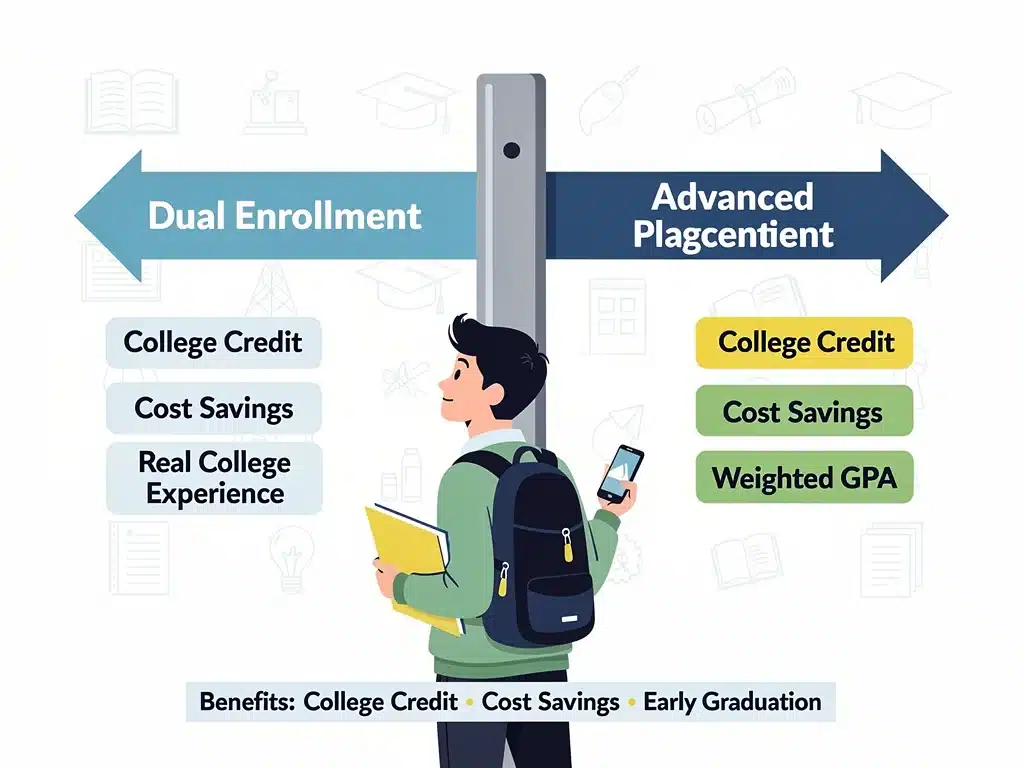
Case Studies: Real-World Impact
Numerous students across the United States have successfully leveraged Dual Enrollment and Advanced Placement programs to accelerate their college degrees. These real-world examples highlight the tangible benefits and strategic choices made.
One student from Arizona earned 24 college credits through a combination of Dual Enrollment courses at a community college and AP exams, allowing her to enter a four-year university as a second-semester sophomore. This saved her a significant amount in tuition and time.
Another example involves a high school senior in Florida who completed 18 credits via AP exams, specifically in STEM subjects.
This enabled him to bypass introductory courses in college and dive directly into more advanced material, aligning with his engineering aspirations. These demonstrate the power of Dual Enrollment vs. Advanced Placement.
Student Success Stories
These success stories often share common themes: proactive planning, strong academic motivation, and supportive educational environments. Students who thrive in these programs are typically organized and committed to their studies.
Many attribute their smooth college transition and early graduation to the foundational knowledge and experience gained during high school. The confidence built from succeeding in college-level work is an invaluable asset.
These narratives underscore that while both Dual Enrollment and Advanced Placement offer distinct paths, their ultimate goal for students is the same: to gain a competitive edge and achieve their academic and career goals more efficiently. The impact of Dual Enrollment vs. Advanced Placement is evident.
| Key Feature | Dual Enrollment vs. Advanced Placement |
|---|---|
| Credit Awarded | Direct college credit upon course completion. |
| Learning Environment | College campus, high school with college instructor, or online. |
| Cost Implications | Tuition often reduced or free; significant savings. |
| College Recognition | Credits widely accepted, but always verify transfer policies. |
Frequently Asked Questions About College Credits in High School
The primary benefit is accelerating degree completion, which can lead to significant savings on college tuition and related expenses. It also provides students with a head start on their college curriculum and a smoother transition to higher education, fostering greater academic confidence and preparedness.
While Dual Enrollment credits are generally considered college credits, transferability varies by institution. It is crucial for students to confirm with their prospective four-year colleges about their specific transfer policies and how these credits will apply to their chosen degree program.
Most colleges grant credit for AP exam scores of 3, 4, or 5, though policies differ. Some universities may require higher scores for specific courses or only offer elective credit. Students must check each university’s AP credit policy directly for accurate information.
Both programs offer cost savings. Dual Enrollment can be free or low-cost, directly reducing tuition. AP involves an exam fee, but successful scores can eliminate the need for costly college courses. The ‘better’ option depends on individual program availability and college acceptance policies.
Yes, many students successfully combine both Dual Enrollment and AP programs to maximize their college credit accumulation. This hybrid approach can be highly effective in reaching the goal of 15 or more college credits, further accelerating degree completion and enhancing academic profiles.
Looking Ahead: Strategic Educational Pathways
The choice between Dual Enrollment vs. Advanced Placement represents a pivotal decision for high school students aiming for higher education.
Both paths offer distinct advantages in accelerating degree completion and mitigating the financial burden of college. As the educational landscape evolves, understanding these options becomes increasingly vital for informed decision-making.
Families should proactively engage with school counselors and college admissions departments to tailor a strategy that best suits the student’s academic goals and financial circumstances.
The focus must remain on maximizing credit transferability and ensuring academic preparedness for the university environment.
The trend towards early college credit acquisition is gaining momentum, reflecting a broader shift in how students approach their post-secondary education.
By strategically utilizing Dual Enrollment vs. Advanced Placement, students can carve out efficient and cost-effective pathways to their degrees, setting a strong foundation for future success.